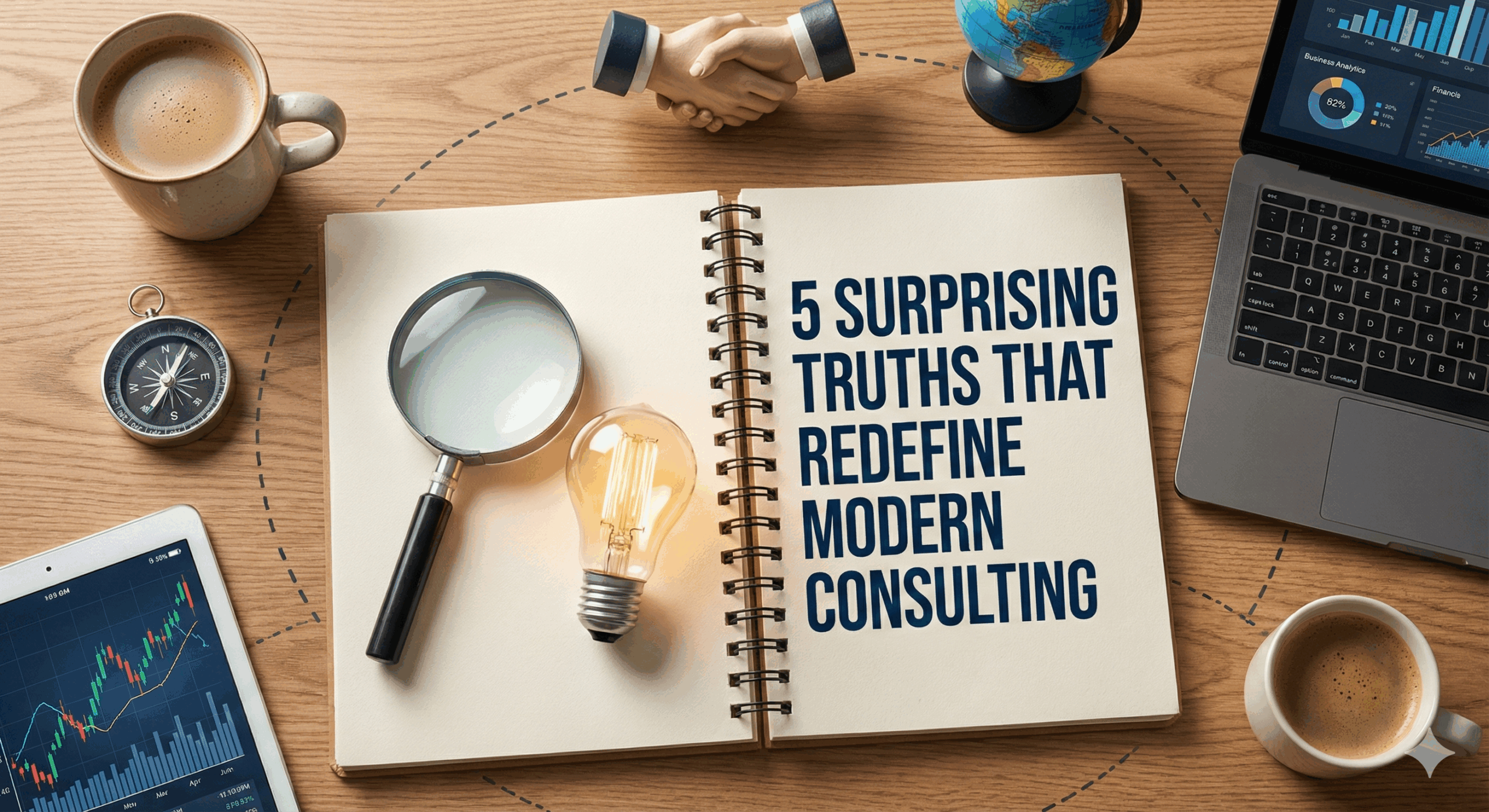
When you think of business consulting, familiar images might come to mind: sharp suits, complex charts, and high-level strategic advice. But in an era defined by rapid technological change and interconnected challenges, what does it truly take to solve complex, real-world problems and drive lasting change?
By looking closely at the principles of a modern consultancy like KZM, we can uncover some powerful and counter-intuitive ideas about what works today. More importantly, these five truths don’t operate in isolation; they form an interconnected system where trust enables structured innovation, disciplined governance de-risks new technology, and diverse perspectives fuel the entire process. This article explores five impactful takeaways that are redefining modern consulting.
Trust Isn't a Byproduct, It's the Foundation
In a tech-obsessed world where solutions often lead with software and systems, it’s surprising to find a philosophy that deliberately places people first. KZM’s approach is built on the classic consulting trio of People, Process, and Technology, but with a specific and meaningful hierarchy.
- People: Represent trust, growth, understanding goals, and empowering teams—the adaptable, human element.
- Process: Provides clarity and is guided by collaboration. The process serves the people, not the other way around.
- Technology: Is an enabler and a proof point, used to deliver data and measure success, but it is not the primary driver.
This “integrity-led” approach is impactful because it prioritizes building long-term relationships over short-term transactions. For complex challenges that require deep collaboration and honesty, trust cannot be an afterthought—it must be the foundation upon which everything else is built.
KZM Consulting anchors everything around integrity, we earn trust first, advice and solutions follow from that.
Innovation Can Be a Repeatable Service, Not a Random Accident
Innovation is often viewed as an unpredictable flash of genius or a lucky accident. However, a modern approach reframes it as a structured, repeatable, and deliverable service. This philosophy moves creativity from the realm of chance to the discipline of a managed process.
Innovation can be operationalized through defined frameworks that turn abstract ideas into tangible outcomes. This includes:
- Establishing structured ideation programs and innovation pipelines to generate and prioritize valuable ideas.
- Running controlled experiments, rapid prototypes, and proofs-of-concept (PoCs) to validate concepts before committing to major investment.
- Conducting systematic “technology scouting” to evaluate emerging trends and solutions for their practical fit and potential impact.
This approach is incredibly valuable because it de-risks the process of adopting new technology. It fosters a sustainable culture of practical creativity, ensuring that innovation is not just a buzzword but a reliable engine for improvement. But a reliable engine for innovation also requires a robust chassis of governance to steer it effectively.
From Labs to Live Projects: Applying Emerging Technologies Responsibly
Complex Projects Demand "PMO-as-a-Service"
As business initiatives grow in scale and complexity, the need for disciplined oversight becomes critical. A Project Management Office (PMO) provides the governance, consistency, and transparency required to keep large-scale programs on track. However, building and maintaining an expert internal PMO can be a massive undertaking.
The modern solution is offering this capability as a managed service. “PMO-as-a-Service” provides organizations with scalable, expert oversight without the overhead of a large internal team. This model focuses on delivering key outcomes like “consistent delivery frameworks,” “full visibility of performance,” and ensuring “alignment between strategy, execution, and measurable outcomes.”
The impact is profound. This model provides the certainty and disciplined governance needed to deliver large-scale programs successfully by providing scalable expertise, ensuring stakeholder alignment across the supply chain, and delivering assurance through structured quality reviews. It transforms project management from a fixed internal cost into a flexible, outcome-focused service.
Structured delivery, clear governance, and outcomes you can measure.
The Future is Modeled with Digital Twins
This level of disciplined governance is often powered by surprisingly tangible tools designed to de-risk major decisions. One of the most powerful is the “Digital Twin.” Far from being science fiction, a digital twin is an advanced simulation environment that replicates a real-world system, allowing organizations to test, predict, and optimize in a virtual world before implementing changes in the physical one.
In simple terms, it’s a dynamic digital copy of a physical asset or process. This can include models of “infrastructure networks, operational workflows, or environmental conditions.” The technology allows organizations to run what-if scenarios, identify potential risks, and fine-tune performance in a safe, controlled environment.
The impact of this technology is a fundamental shift from reactive decision-making to proactive, data-driven planning. By simulating the future, organizations can build more resilient systems, reduce operational risk, and make smarter investments with a much higher degree of accuracy.
Digital twins provide real-time insights, scenario testing, and optimisation opportunities. These tools help organisations plan more effectively, reduce risk, and make data-driven decisions with greater accuracy.
The Biggest Insights Come from the Widest Perspectives
Conventional wisdom often suggests that the deepest expertise comes from hyper-specialization in a single industry. However, a modern, counter-intuitive approach argues that the most innovative solutions arise from combining knowledge across multiple sectors.
KZM’s philosophy is built on “cross-sector expertise,” combining knowledge from industries as diverse as Agriculture, Financial Services, Health, and Infrastructure. This isn’t just theory; it’s a core tenet of their delivery model. For instance, the same “PMO-as-a-Service” framework used to provide governance for a large-scale civil infrastructure project is applied to manage a digital transformation in Financial Services or a systems modernization in Health. The underlying principles of disciplined governance and measurable outcomes are universal, but the insights gained from each sector make the framework stronger everywhere it’s applied.
This matters because the world’s biggest challenges—from sustainability to digital transformation—are not confined to industry silos. They are interconnected. By applying proven solutions from one field to a seemingly unrelated problem in another, organizations can solve complex problems faster and more effectively.
By combining deep industry knowledge with cross-sector insights, we bring a broader perspective that helps uncover opportunities others may overlook.
Conclusion
Ultimately, these five truths reveal a cohesive model for modern consulting: It begins with an integrity-led foundation of trust, which allows for the creation of repeatable systems for innovation. This innovation is then guided by the disciplined oversight of PMO-as-a-Service, utilizing powerful tools like Digital Twins to model the future. The entire engine is powered by cross-sector insights, ensuring that the solutions are not just technically sound but contextually brilliant.
As our challenges become more complex and interconnected, which of these approaches will be most critical for shaping a better future?
- 1. Define the decision rights and escalation paths upfront.
- 2. Automate data flows from delivery tools into a single dashboard.
- 3. Practice blameless reviews to accelerate learning.
Get in Touch
Speak with our team of experts and find the right solution to your challenges